The Jewish Chronicle reported in 1874 that Mr Hyman Freedman of Aberavon had been appointed an overseer (responsible for administering to the needs of the poor) of the parish of Margam. They believed he was the first Jew in Wales appointed as overseer and at that time the only Jewish resident in the parish.
Port Talbot Synagogue
1919-1950s
3.15 Miles
LOCATION: Ty-Draw Place, Port Talbot, SA13 1LJ
Port Talbot Synagogue
We begin the third part of this trail in an alley running off Ty-Draw place, behind the bank. Here you will find the Port Talbot Spiritualist Church, which used to be a synagogue.
1874: First Jewish overseer in Wales
1900s: The origin of an organised community
Isaac Factor, the last president of the Aberavon and Port Talbot Hebrew Congregation, relates that in around 1900, a Jewish student, named Rafael Levi, at an Orthodox religious school left his native town of Salant, in Lithuania, "a place renowned for its learned scholars and famed for its Orthodoxy." He left to avoid being called up for military service by the Russian Empire. He came to London, where friends advised him to come to Swansea because a cousin, Mr H. Deggotts, was a ‘traveller’ there. Levi also became a travelling peddler, and eventually came to Aberavon, prospered, and opened a drapery shop in Port Talbot, trading under the name of Raphael.
By this time there were several Jewish families in Port Talbot and Aberavon with boys approaching bar mitzvah age, however there was no officially organised community. Raphael Levi “concerned himself with the problem of teaching the children” and started a cheder, which is a school specifically to teach children Hebrew and how to read the Torah. A meeting was called and the Aberavon Hebrew Congregation was formed in around 1904 with J. D. Rosenberg, who had come from Llanelli, as President and Rev. Fogelnest as minister.
Meat for the community was brought over from Swansea by Mr Deggotts in his horse and cart. The community did not have its own Jewish cemetery, so burials took place in Swansea.
Meanwhile, the Jewish community increased but split into two congregations due to disagreements, including how strictly to observe the sabbath. The Aberavon congregation continued under the Presidency of Mr Rosenberg, and a second, called the Port Talbot Hebrew Congregation, was formed under the presidency of Mr Aaron Factor, who was Raphael Levi’s cousin. They had their own shochet (ritual slaughterer), butcher shop and teacher.
1913: Communities united
Likely due to declining numbers in Aberavon, the communities were reunited in 1913 and named the Aberavon and Port Talbot Hebrew Congregation with Aaron Factor becoming the first President, N. Stern as Treasurer and Secretary and Rev. A. Scheinrock as chazan (cantor and leader in prayer and song), shochet and teacher.
1919 – 1921: Synagogue opened
A purpose-built synagogue was erected at some point between 1919 and 1921. It was a single-storey building off Ty-Draw Place, down a lane behind the former Barclays Bank at 48 Station Road.
David Factor describes the interior in his oral history interview:
“It was a ground floor building only with the ark where the scrolls of law were kept was at one far end. There was what we call a bimah, which is the raised platform where the minister does the service or where they take the service, was in the middle of the building. There were benches which were the seats on each side of the bimah and then there was a section then not roped-off, but it was sectioned-off with wooden panels and behind that the ladies sat.”
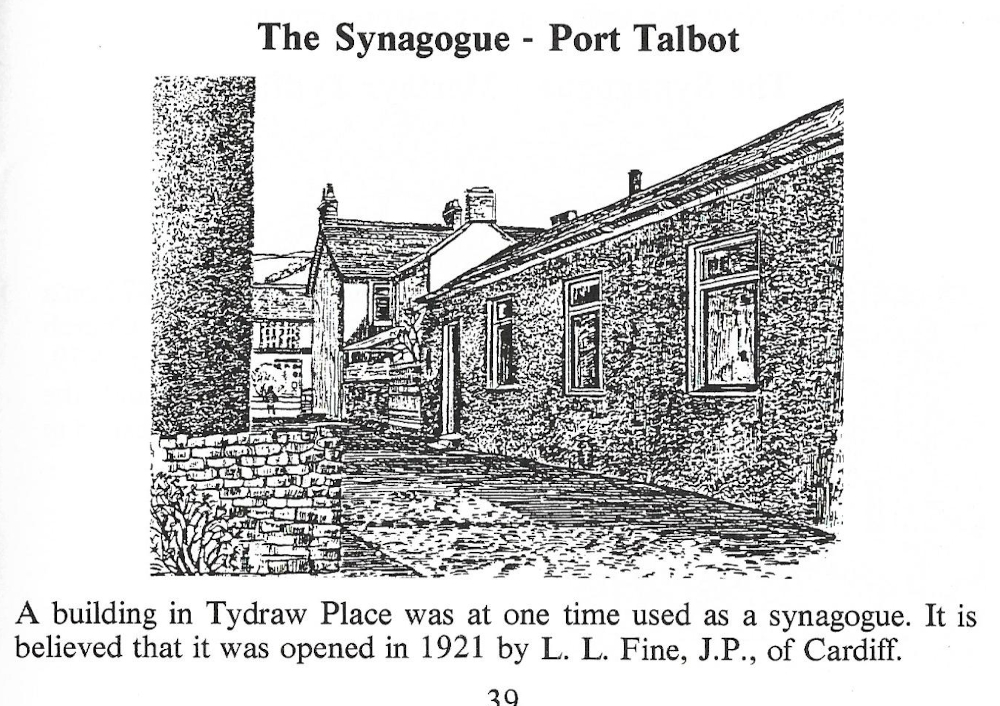
Drawing of Port Talbot Synagogue by Olwen Hughes.
Image: Cajex, vol. 38, No. 1, p. 39
The original drawing is now in the collection of St Fagans National Museum of History.1936 – 1942: Rabbi Maurice Landy
The last minister of the Aberavon and Port Talbot Hebrew Community was Rabbi Maurice Landy, who was born in Llanelli in 1913 and served the Aberavon and Port Talbot congregation from 1936 until he moved away in 1942. during this time, he also lectured extensively to non-Jewish gatherings about Jewish subjects and was also active on the wartime Joint Emergency Committee. At the beginning of the Second World War, Rev. Landy also spoke to many non-Jewish groups about the plight of the Jewish refugees in Europe and raised many donations to aid the cause. Rev. Landy’s lectures would have titles such as “World Problems cannot be solved by the Destruction of the Jew” and “The Jewish Problem” very much placing antisemitism at the centre of his talks. He would lecture to, Wesleyans, Methodists, Baptist groups, and many others in pursuit of greater understanding and tolerance towards the Jewish people.
The heyday of the Aberavon and Port Talbot community was noted in the Jewish Year Book figures of 1934, when there were 99 members. By 1946 this had halved.
1950s: Decline
By the 1950s the Jewish community in Port Talbot had steadily declined and there were only a few Jewish families left. The synagogue closed in the early 1950s, leaving no Jewish buildings or amenities for the remaining Jewish families. Welsh-Jewish comedian, Bennett Arron recalls that his family had to attend synagogue in Swansea and go to a Cardiff butcher to keep kosher.
In 1976 the former synagogue building was bought by Port Talbot Spiritualist Church, which opened the following year. The Spiritualists thought that the Jewish community was very unhappy about this purchase; during the years since many mediums have described a rabbi walking up and down the aisle. “The last time he was seen he was smiling, so church members confidently believe that spiritualists have been accepted by the synagogue's former owners.”
(In fact, all the community were happy with the sale apart from one, who hoped that the community could be revived and the synagogue reopened.)
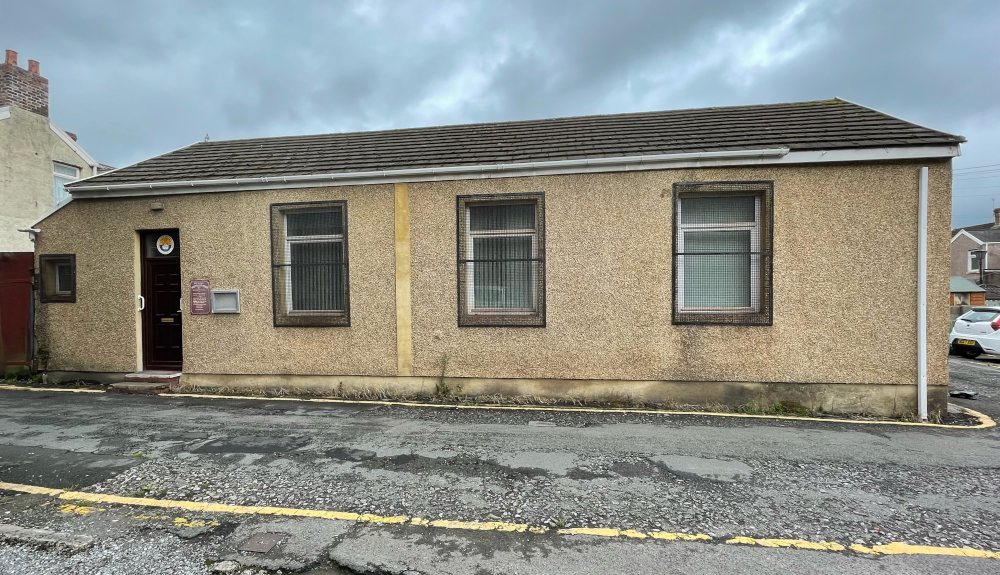
The former Port Talbot Synagogue today.
Image: Christine Hawkins, 2023.
Sources (16) click to show
CONTINUE THE TRAIL
Trail
×
![]()