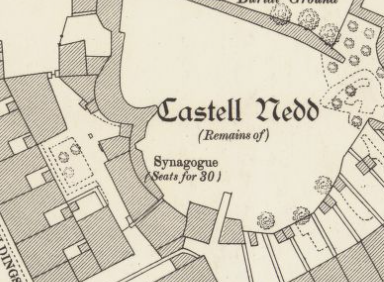
A synagogue was established in Neath in 1867. The congregation in Neath was small and the construction of a local synagogue saved the community having to travel several miles to Swansea to worship on the sabbath.
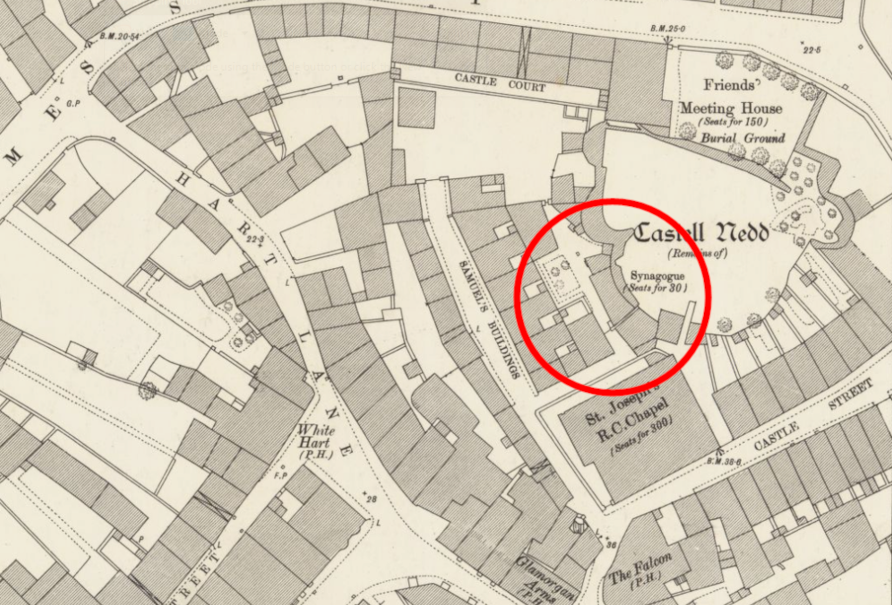
Neath Synagogue 1878 (near Castell Nedd).
Ordnance Survey Reproduced under a Creative Commons Attribution-NonCommercial-ShareAlike 4.0 International (CC-BY-NC-SA) licence with the permission of the National Library of Scotland.
The synagogue was built next to the ruined castle walls and could accommodate 30 people. Its construction is credited to one man, Lazarus Samuel, who was a local businessman.
The synagogue was built on land that Lazarus owned, and the foundation stone was laid on 14 April 1867 by his wife, Rachel. The area in front of the synagogue was a street of terraced houses and cottages, known as Samuel’s Buildings, but these have now been demolished.
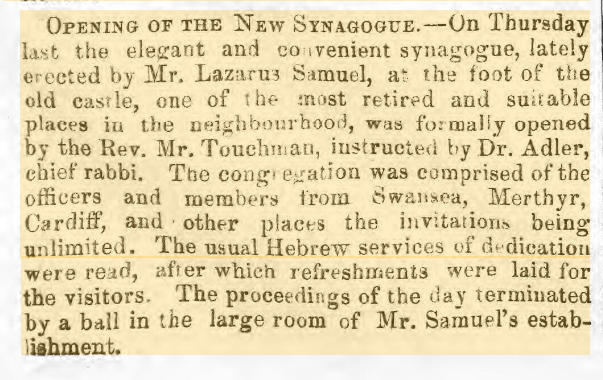
Lazarus did not spare any expense on his synagogue. According to an article in The Jewish Chronicle in 1868, there were only three other known synagogues (in England) built at the expense of one individual. Even though it was small, it contained all the features of larger buildings. The ark was made from New Zealand teakwood and was covered in a sumptuous cloth of crimson and gold, bearing the words “Consider well before whom thou standest” in Hebrew. There were two bronzed Corinthian pillars either side of the Ark. The reading desk was constructed from polished Spanish mahogany and there were two stained and frosted glass windows which were described as ‘magnificent’. Opposite each of the seats in the synagogue was a moveable reading desk which could be easily removed if more space was required on high holidays.
There was a ladies’ retiring room which had a toilet, and a similar retiring room for the readers and officers. Lazarus Samuel also anticipated the needs of the congregation for a sukkah during Sukkoth, and constructed a building opposite the ladies’ entrance where the roof could be removed for this purpose. For the remainder of the year this building was used as a cloakroom. The grounds surrounding the synagogue were also beautifully landscaped with a grass plot, flowers and fruit trees.
However, by 1880, the synagogue was only opened for New Year and Pentecost (known as Shavuot). The family of Lazarus Samuel were still responsible for the building, and they welcomed any co-religionists who happened to be in Neath during these festivals.
Shortly after this, the synagogue closed permanently, meaning that the Neath Jewish congregation lasted for only 13 years.