Mettoy

The manufacturer of Corgi toys

3.15 Miles

LOCATION: Queensway, Fforestfach, Swansea

Mettoy

The toy company Mettoy, an abbreviation of ‘Metal Toy’, was a national and international success. This business was founded by Jewish businessmen Philipp Ullmann (1883-1971) and Arthur Katz (1908-1999).

The company was praised not only for its quality products and constant innovation in the toy industry but also for providing great employment opportunities to people across south Wales, mainly in the Swansea area.

1883 – 1912:  Philip Ullman and Arthur Katz

Philipp Ullmann was born in 1883 in Nürnberg, Germany, to Isaak and Emilie Ullmann.

Arthur Katz was born in 1908 in Johannesburg, South Africa, to Hermann and Regine Katz (née Ullmann). Regine was Philipp’s cousin.

Both Philipp and Arthur had considerable experience in toy manufacturing. In 1912, Philipp founded Tipp & Company, a mechanical pressed tin toys manufacturer, in Nürnberg; Arthur joined Tipp & Co. when he left school.

1933 – 1934:  A new place to call home

Philipp and Arthur were both Jewish and in 1933, they left Germany due to the rise of Hitler and increasing Nazi persecution. The Nazis later seized Tipp and Co. under a process known as ‘Aryanisation’.

In 1934, they set up a new toy manufacturing company, Mettoy, in Northampton, England, and started manufacturing toys to raise funds for other Jewish refugees. The company marketed a range of attractive tinplate toy vehicles designed to compete with Dinky Toys, produced by the British company Meccano Ltd.

1941 – 1944:  Toy trade stopped and Fforestfach

The Second World War brought a temporary stop to toy manufacturing. To assist with Britain’s’ war effort, Mettoy produced munitions and military equipment at their Northampton premises and at a 28,000-square-foot factory acquired for that purpose in Fforestfach.

The company returned to manufacturing toys after the Second World War.

1948:  The Fforestfach factor's expansion

In 1948, Mettoy began to build a new 115,000-square-foot modern factory at Fforestfach. The location was attractive due to the ready availability of raw materials and because it was located in an area of high unemployment. The factory was opened in April 1949 by King George VI. The space was large enough to accommodate the Mettoy’s production and commercial sections. By 1952, it had become the company’s headquarters.

Mettoy continued to grow in the post-war period, expanding its range of products.

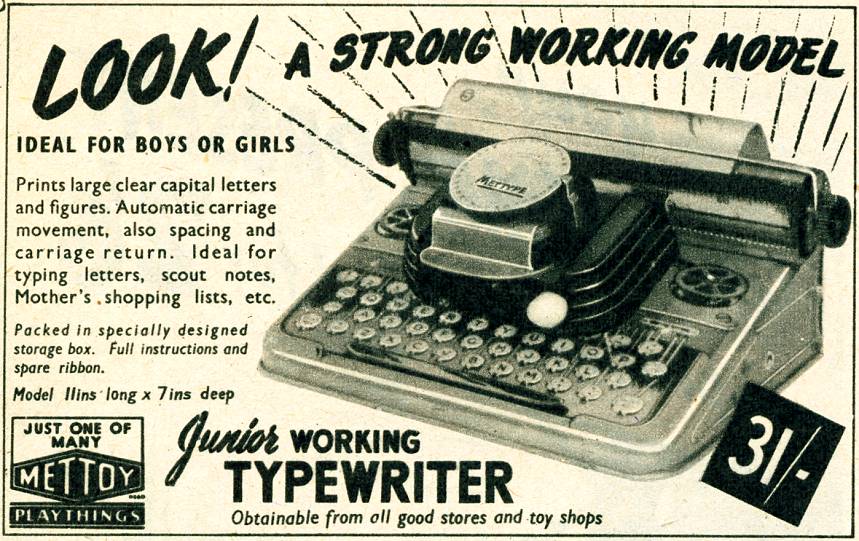
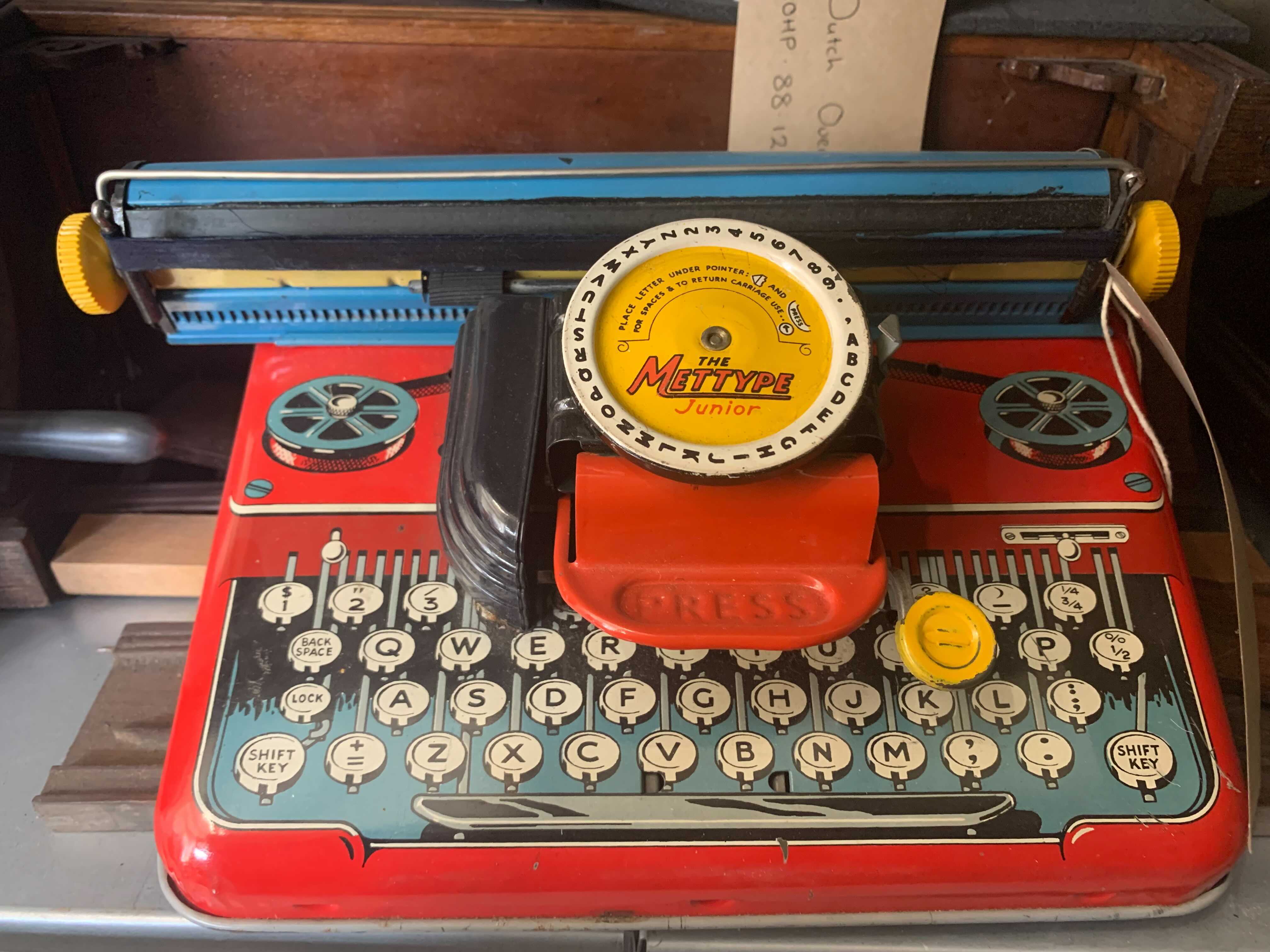
Advert for Junior working Typewriter. 'Look a strong working model. Ideal for boys or girls.'
 
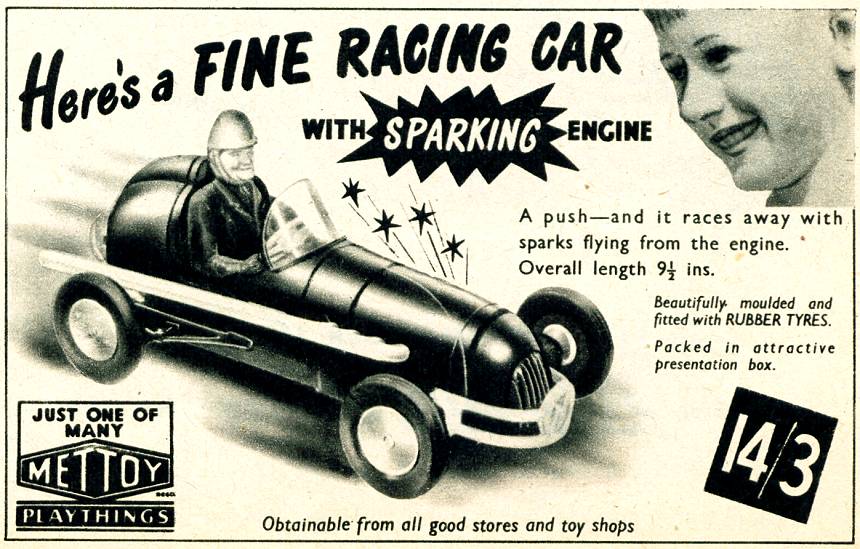
Advert for 1953 racing car: 'Here's a fine racing car with a sparking engine.'

Two posters from 1953 advertising Mettoy products: Junior Typewriter and Racing Car.

Image: Grace's Guide to British Industrial History.

1956:  Corgi toys launched

In 1956, the company launched the Corgi Toy range. The Welsh dog breed name was chosen because it was short and catchy, because the models were produced in Wales, and because of its association with the Royal Family.

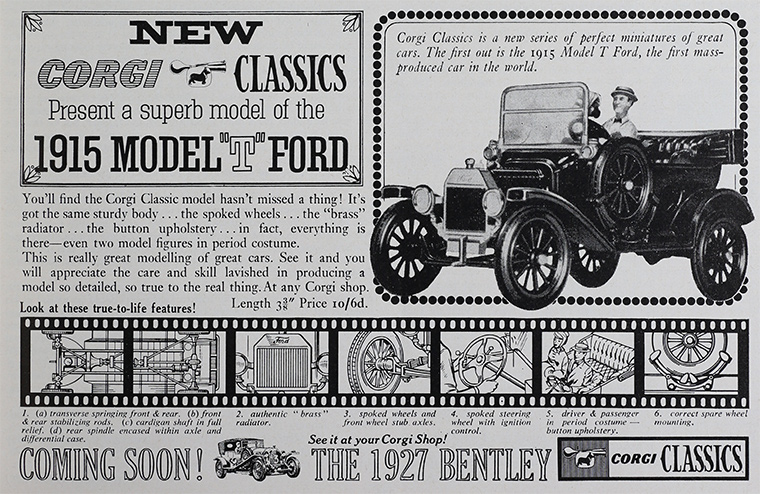
Advert: Corgi Classics present a superb model of the 1915 model Ford.
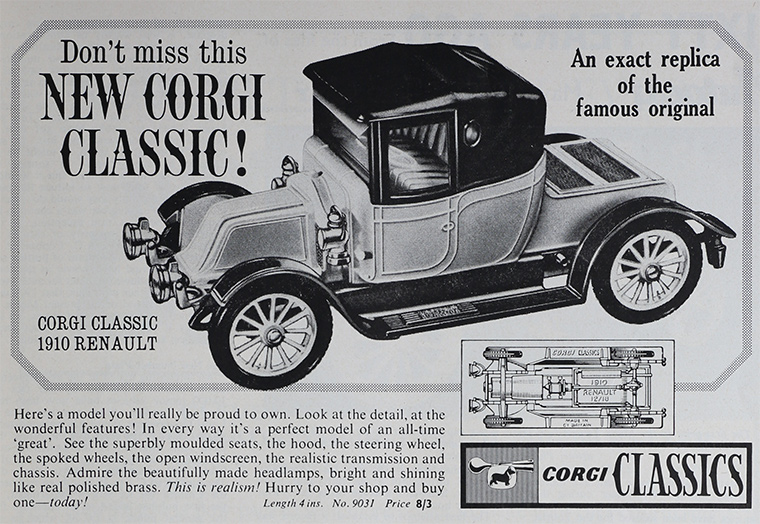
Advert: Don't miss this new Corgi  Classic 1910 Renault!
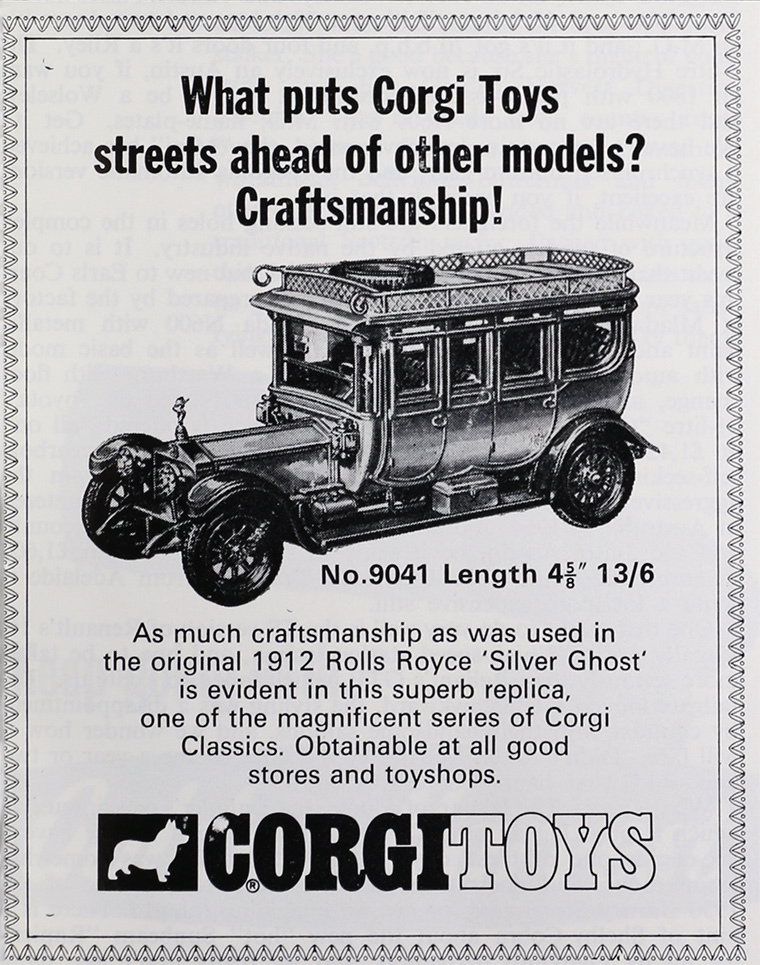
Advert for 1910 Rolls Royce 'Silver Ghost'. What puts Corgi streets ahead of the other models? Craftsmanship.'

Three posters from 1953, 1964, and 1968 advertising Corgi Toys.

Image: Grace's Guide to British Industrial History.


The range of products expanded into toy domestic appliances such as washing machines, carpet sweepers, and dolls’ houses and furniture.

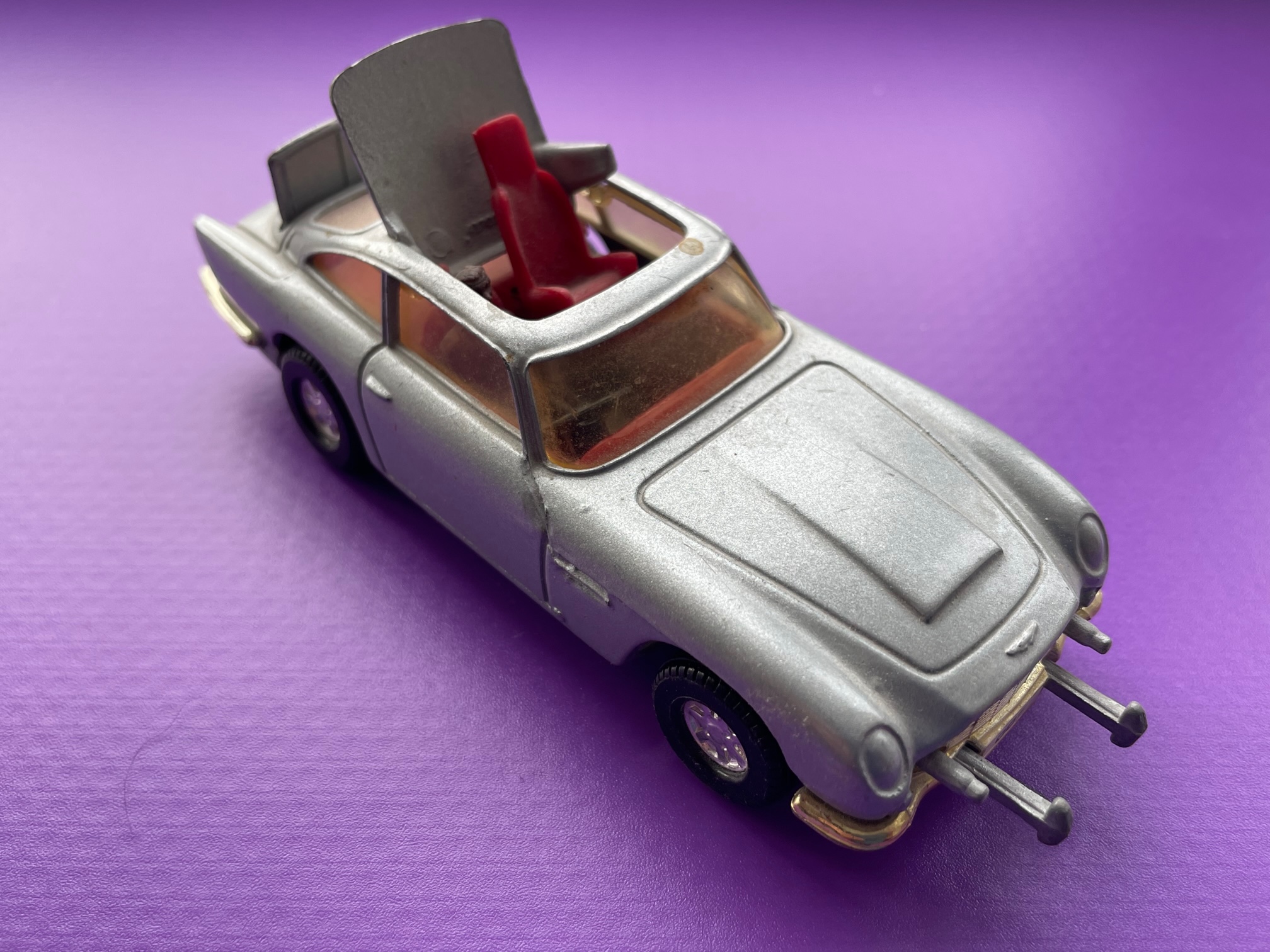
During this period, the company was at the height of its popularity. In 1966, the James Bond Aston Martin DB5 model was voted the Toy of the Year. By 1969, over four million had been sold. The model showed the company’s innovation and love of gadgets. It featured an opening roof and working spring-loaded ejector seat, retractable machine guns, telescopic bumper over-riders, and a pop-up bulletproof metal screen. It became the most famous Corgi Toy ever produced.

Photograph of model of grey James Bond's Aston Martin.

James Bond Aston Martin.

Image: JHASW/CHIDC, 2023.


1968  The company's workers

The company contributed in many ways to the social and economic life in Swansea. It is suggested that the production and trading activities of companies such as Mettoy and Louis Marx (which we will meet next on this trail) contributed to the Swansea Industrial Estate being the ‘hub of an increasing world-wide export trade.’  In 1968, the company’s factories and warehouses combined were 385,000 square feet and accommodated a workforce of 3,500 people. The company survived a disastrous fire at the Fforestfach Queensway warehouse in 1969.

An aerial view of the factory showing large building with 11 gabled roofs and separate buildings around.

Mettoy Factory in Fforestfach, 1972.

Image: People’s Collection Wales.

Created by Aerofilms Ltd.

Mettoy provided work for a lot of women, which was considered significant at that time. Cynthia Rix recalls that during her time working at the factory ‘there weren’t many men there, and they were mainly the bosses.’ Also, It has been suggested that Mettoy was known for employing many people in the deaf community throughout Swansea. The assembly line was so noisy that workers had to lip read or pass notes down the assembly line. Cynthia said, ‘There was fairness there, there was togetherness there. We were all a team.... You enjoyed going to work.’ 

Other workers may have been less enthusiastic, but Mettoy was considered a better employer than some other Jewish firms on the estate, like Llamas who made knickers ‘for old ladies’, football jerseys, scarves, but mainly garments for men” and Windsmoor who made mainly women’s garments such as coats and skirts.       
1980s  End of an era

In 1981, the company recorded record losses. It continued to decline during the early 1980s due to the rise in popularity of electronic toys and games. In 1982 Mettoy launched the Dragon computer, but shortly after sold this off. There was a management buy-out of The Corgi Toy Company, including the Swansea factory, in 1984. Mattel purchased the factory in 1989 and the Swansea factory and office closed in 1991 when Mattel moved to Leicester.

2008  Corgi owned by Hornby

In 2008, the Corgi brand was acquired by Hornby, who also owned Scalextric and Airfix.

Sources (24) click to show

CONTINUE THE TRAIL

Trail