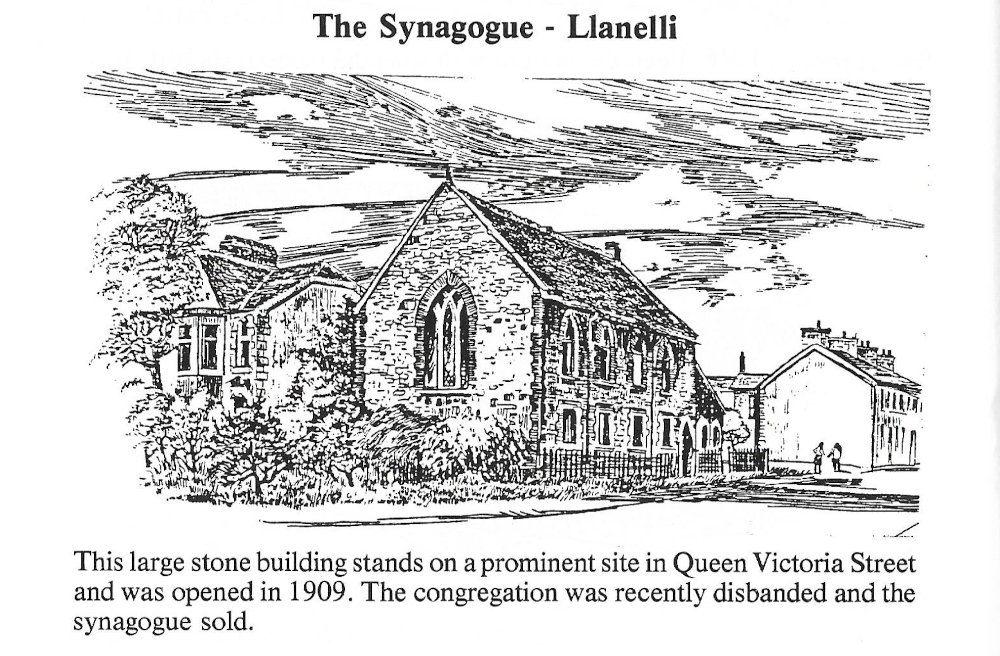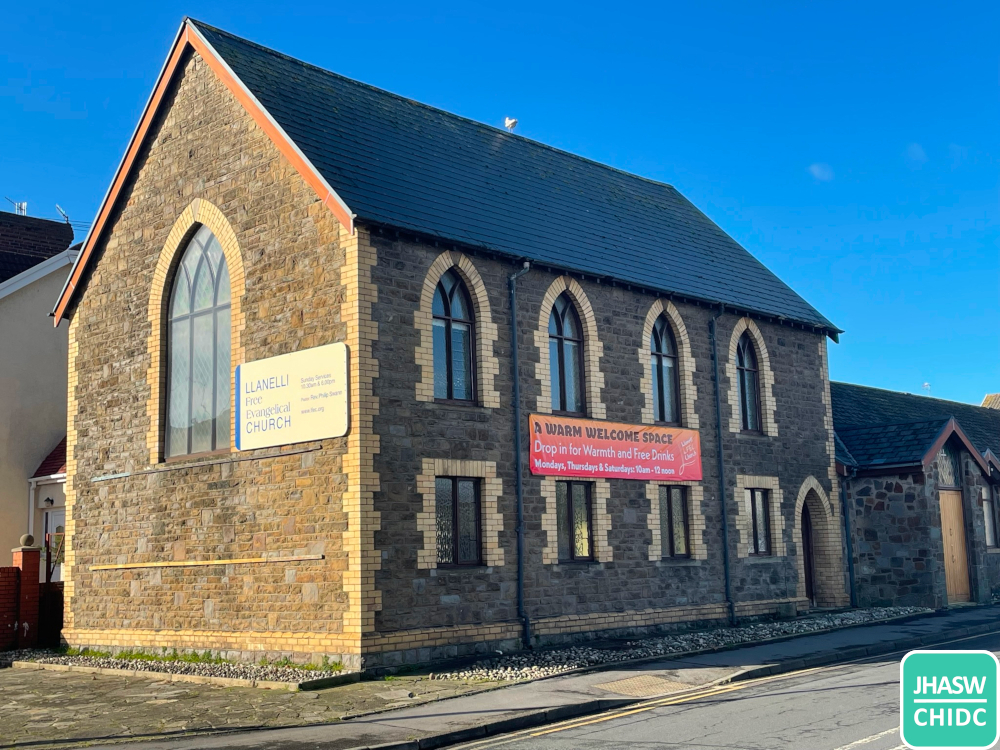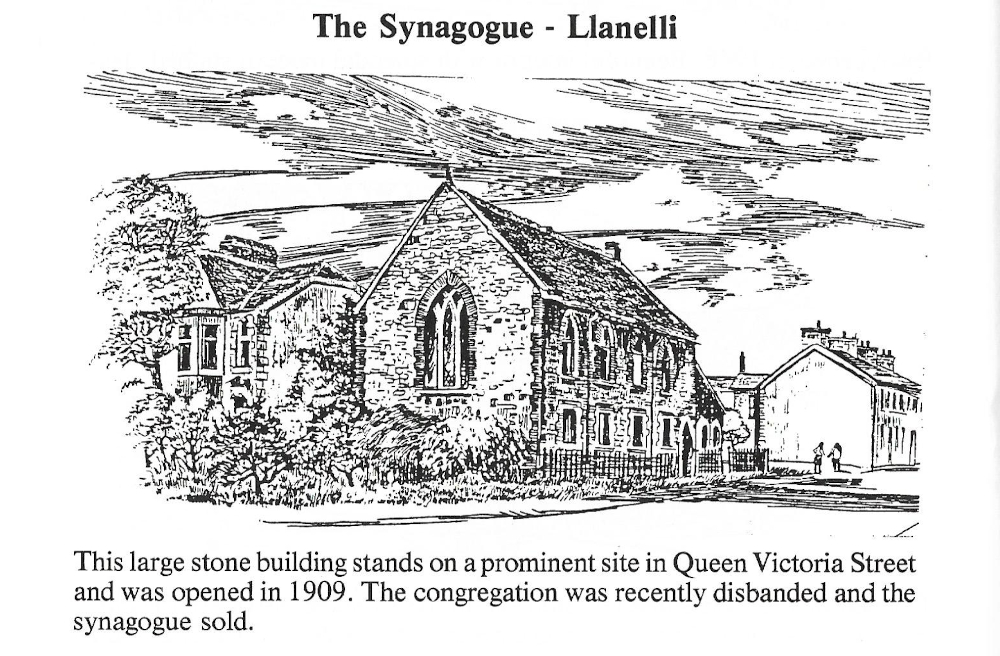
The earliest mention of a Jewish presence in Llanelli is found in the London Gazette dated 23 August 1872. The article details the dissolution of a partnership between two brothers who had a pawnbrokers, jewellers and glass dealers in Murray Street. The business of Louis and Michael Newmark was dissolved on 11 January 1872, suggesting that they had already settled in Llanelli and established their business before this time.
A rather more romanticised version of the beginning of the community was told by Mr Harris Rubenstein in 1955. Harris had been treasurer at Llanelli Synagogue for 25 years, and he recounted that in 1880, his mother’s brother decided to emigrate to the USA. The ship drifted for three weeks before docking in Swansea instead of America. Only a few of the 600 people on board stayed in the area. By this time there were half a dozen Jewish families in Llanelli, but they had to travel to the synagogue in Swansea for festivals.
The area had become an attractive prospect for Jewish entrepreneurs due to the growth of the metal and mining industries in south Wales. In 1887, Isaac Benjamin arrived in Llanelli with his two brothers, Lewis and Morris, who were all glaziers. Ten years later in 1897, Harris Rubenstein along with his brother and the three Benjamin brothers began holy day services at what became the Albion Inn on Murray Street, and as their numbers grew, they moved to Castle Buildings which was also on Murray Street. Sabbath services were held in the parlour of Harris Rubenstein’s home.
The congregation was officially formed in 1900, with Isaac Benjamin as President and Harris Rubenstein as Treasurer. Mr. Lipman was the first paid official, followed by Isaac Solomon (Yitschok Shloime Solomon), who settled in Llanelli in around 1905. Isaac was a shochet (kosher butcher) and ba’al tefila (leader of religious worship in the synagogue). He accepted a call which took him from London to the newly formed Llanelli Hebrew Congregation. He received a weekly wage of £1. 5s. 0d. He and his wife, Kendy, regarded Llanelli as eck velt - the end of the world. Later, their family members also moved to Llanelli as they praised how the air was fresh and clean compared to the polluted air in London. Isaac learned to speak Welsh and owned a small grocer’s shop attached to his house to subsidise the low weekly wage for his religious duties. In his Llanelli Hebrew classes he taught many who went on to become rabbis all over the UK, from Edinburgh to Brighton. Solomon’s own son became the spiritual head of a community in California.
The Llanelli Hebrew Congregation was officially inaugurated in 1902, when there were still very few Jews in the area.
There is little evidence of any negative reactions of the local community to their new Jewish neighbours, but it is known that some converted Jews were brought to Llanelli to preach as part of the Christian revivalist effort there, and attempts were also being made in Llanelli to ban shechita (the act of ritual slaughter for kosher meat). An article from the Jewish Chronicle dated 7 February 1904, describes a meeting of the Lanelly Estates Committee, where the Veterinary Inspector said that the method of slaughtering used by the Jewish community at the Llanelli slaughterhouse amounted to cruelty because the animals were not stunned first.
In 1905, reports in the Jewish Chronicle state that Llanelli now had 70 Jews living there, compared to 400 in Swansea. They had no minister at this time, but Rev. S. Fine of Swansea became the visiting minister to the Llanelli community.